How to Study the Bible
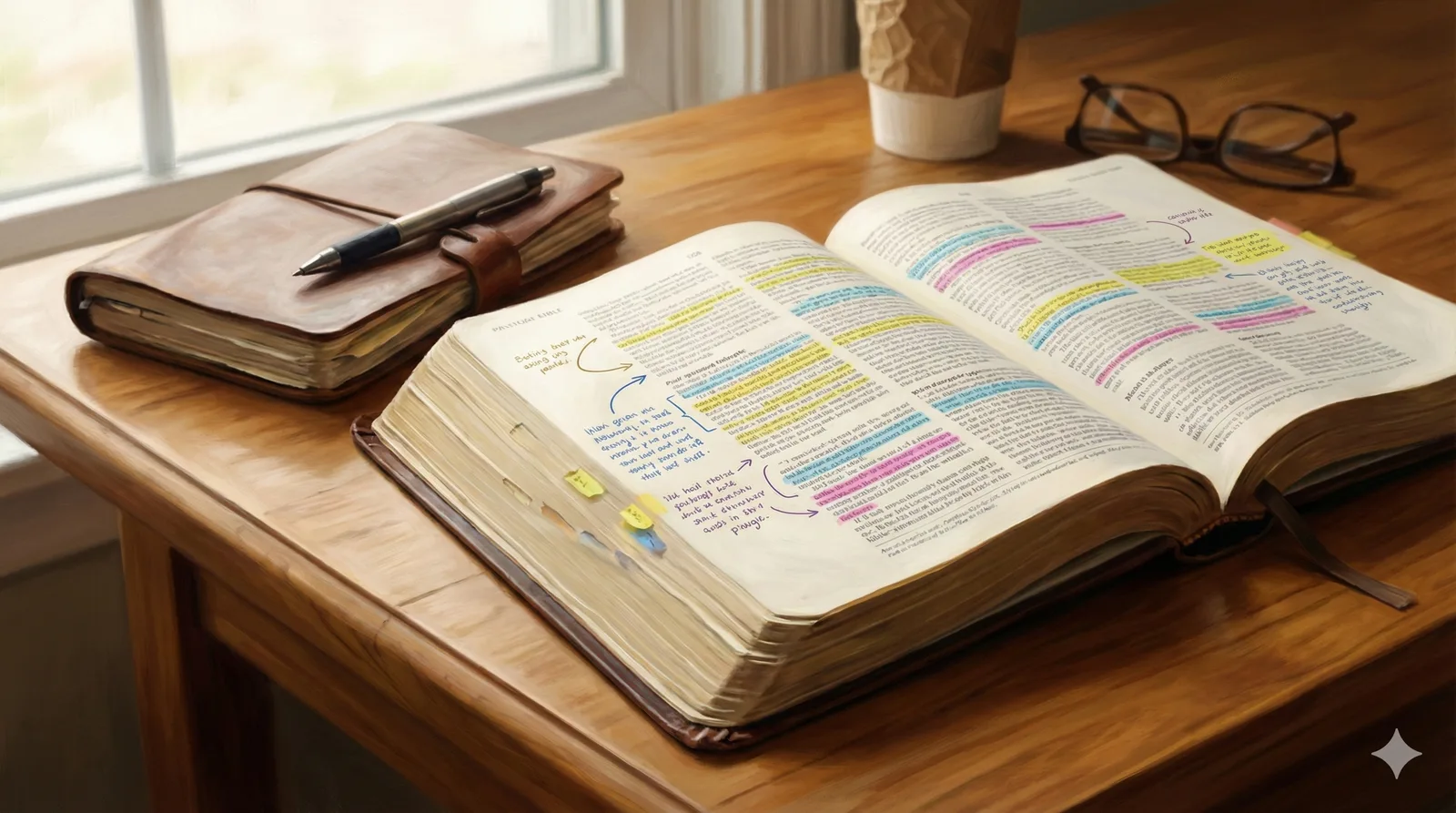
The Bible isn't just a book to read. It's God's living Word meant to be studied, understood, and applied. This 5-week course teaches you the HEAR method (Highlight, Explain, Apply, Respond), a simple but powerful framework for engaging with Scripture that you can use for the rest of your life.
What you'll learn
- 1
Session 1: Why Study the Bible & Introducing HEAR
Explore why God's living Word matters and learn the simple HEAR framework to guide your lifelong Scripture study.
~45 min - 2
Session 2: H - Highlight: What Stands Out?
Learn how to slow down and observe Scripture closely by highlighting key details, questions, and repeated themes in reading.
~45 min - 3
Session 3: E - Explain: What Does It Mean?
Discover foundational principles of biblical interpretation to clarify context, original meaning, and core truths before applying scripture.
~45 min - 4
Session 4: A - Apply: How Does This Change My Life?
Move from reading Scripture to doing it by turning biblical insights into personal, action-oriented steps for daily living.
~45 min - 5
Session 5: R - Respond: Talking Back to God + Building a Lifelong Habit
Close the loop by turning your Bible study into honest prayer and practical habits for a consistent quiet time.
~45 min
Sample lesson
Session 1: Why Study the Bible & Introducing HEAR
Why Study the Bible & Introducing HEAR
The Bible isn't just an ancient book of rules or a collection of stories. It's God's living Word, and it's meant to be studied, understood, and applied. But for many people, opening the Bible feels intimidating. Where do you start? What if you don't understand it? What if it was written so long ago that it doesn't apply anymore?
In this session we answer the most basic question: Why study the Bible at all? And we introduce a simple, repeatable framework called HEAR that will guide you through the rest of this course, and the rest of your life.
The Bible Is God's Living Word
14But as for you, continue in what you have learned and have become convinced of, because you know those from whom you learned it, 15and how from infancy you have known the Holy Scriptures, which are able to make you wise for salvation through faith in Christ Jesus. 16All Scripture is God-breathed and is useful for teaching, rebuking, correcting and training in righteousness, 17so that the servant of God may be thoroughly equipped for every good work.2 Timothy 3:14-17 · NIV
Paul tells Timothy that all Scripture is God-breathed, useful for teaching, rebuking, correcting, and training in righteousness. This isn't just Paul's opinion about a good book. He's saying that when you read the Bible, God is speaking. It's not just information: it's revelation.
12For the word of God is alive and active. Sharper than any double-edged sword, it penetrates even to dividing soul and spirit, joints and marrow; it judges the thoughts and attitudes of the heart. 13Nothing in all creation is hidden from God’s sight. Everything is uncovered and laid bare before the eyes of him to whom we must give account.Hebrews 4:12-13 · NIV
The writer of Hebrews says the Word of God is living and active, sharper than a two-edged sword. It penetrates, it divides, it judges. This isn't a dead text sitting on your shelf. It's alive. It reads you as much as you read it.
7The law of the Lord is perfect, refreshing the soul. The statutes of the Lord are trustworthy, making wise the simple. 8The precepts of the Lord are right, giving joy to the heart. The commands of the Lord are radiant, giving light to the eyes. 9The fear of the Lord is pure, enduring forever. The decrees of the Lord are firm, and all of them are righteous. 10They are more precious than gold, than much pure gold; they are sweeter than honey, than honey from the honeycomb. 11By them your servant is warned; in keeping them there is great reward. 12But who can discern their own errors? Forgive my hidden faults. 13Keep your servant also from willful sins; may they not rule over me. Then I will be blameless, innocent of great transgression. 14May these words of my mouth and this meditation of my heart be pleasing in your sight, Lord , my Rock and my Redeemer.Psalm 19:7-14 · NIV
The psalmist says God's Word revives the soul, makes wise the simple, gives joy to the heart, and gives light to the eyes. It's more desirable than gold and sweeter than honey. This is what Bible study unlocks: not just knowledge, but transformation.
10As the rain and the snow come down from heaven, and do not return to it without watering the earth and making it bud and flourish, so that it yields seed for the sower and bread for the eater, 11so is my word that goes out from my mouth: It will not return to me empty, but will accomplish what I desire and achieve the purpose for which I sent it.Isaiah 55:10-11 · NIV
God's Word doesn't return empty. It accomplishes what He sends it to do.
Introducing the HEAR Method
So how do you actually study the Bible? There are many methods, but the one we'll use in this course is called HEAR. It's simple enough for a brand-new believer and deep enough for a lifelong student. Each letter stands for one step:
HEAR works as a journal format. Each time you study, you write under these four headings. Over the next four sessions, we'll spend an entire session going deep on each letter. But here's the big idea: HEAR turns Bible reading into a conversation with God. He speaks through His Word (Highlight and Explain), and you respond (Apply and Respond).
1. What has been your biggest barrier to reading the Bible consistently?
Overcoming Common Barriers
"I don't understand it." That's OK. You don't need a seminary degree. Start with a readable translation like the NLT or NIV. Get a study Bible with notes that explain the context. And remember: understanding grows over time. You don't understand everything about a friendship after one conversation.
"It was written so long ago." The Bible was written in ancient cultures, yes. But the themes (love, loss, fear, hope, sin, redemption) are timeless. And the Holy Spirit bridges the gap between "then" and "now." That's His job (John 16:13).
2. How does knowing the Bible is 'God-breathed' (2 Timothy 3:16) change how you approach it?
"I don't know where to start." Start with a Gospel. Mark is short and fast-paced. John is deep and personal. Or start with the passage we're giving you in this session: Psalm 23. You already know it. Now study it.
One more thing before we start: pray before you study. The psalmist prayed, "Open my eyes that I may see wonderful things in your law" (Psalm 119:18). We approach Scripture with the Spirit's help, not just our intellect. Before you open your Bible, ask God to open your eyes.
The goal of Bible study isn't to get through the Bible. It's to let the Bible get through you.
Discussion Questions
3. Which part of HEAR (Highlight, Explain, Apply, Respond) feels most natural to you? Which feels hardest?
Reflection
Hebrews 4:12 says the Word is 'living and active.' Describe a time when a Bible passage felt personal, like it was written directly to you.
That's a sample lesson. Sign up to complete the interactive workbook and continue the rest of the course.
Sign up to continue →Take this course
How to Study the Bible is open to churches, groups, and individuals on MKDSCPLS.
Get started →