
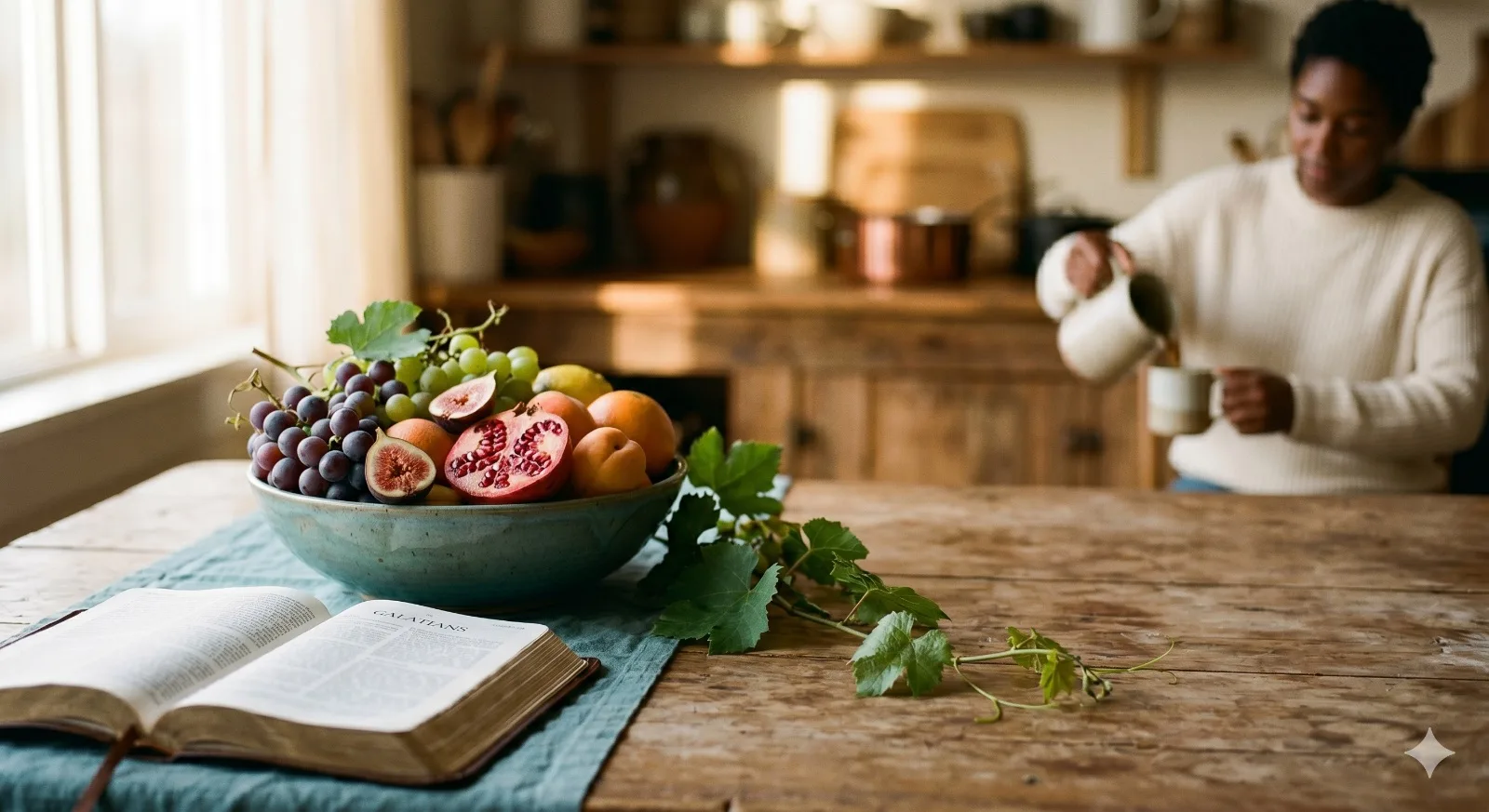
The Fruit of the Spirit
If grace is the root, the fruit of the Spirit is the evidence. This four-session course walks slowly through Galatians 5:22-23, exploring how the nine character traits Paul names are not produced by willpower but grown by the Holy Spirit in a life rooted in Christ. You will study each fruit in its biblical context, see Jesus embody it, and learn to recognize where the Spirit is already at work in you. Designed as a follow-up to "Understanding Grace", but accessible on its own.
What you'll learn
- 1
Session 1: Rooted in the Spirit
An overview of Galatians 5: the difference between fruit and works, and why character grows from being, not doing.
~50 min - 2
Session 2: Love, Joy, Peace
The first three fruits: love that is willed, joy that is independent of circumstance, and peace that is not the absence of conflict.
~50 min - 3
Session 3: Patience, Kindness, Goodness
The outward fruits: how a Spirit-rooted life shows up in the way we treat the people around us, especially when they are difficult.
~50 min - 4
Session 4: Faithfulness, Gentleness, Self-Control
The integrating fruits: the sustained, daily, often-unseen character that holds the others together over the long haul.
~50 min
Sample lesson
Session 1: Rooted in the Spirit
Rooted in the Spirit
If "Understanding Grace" was about the root, this course is about the fruit. Grace is what saves you. The fruit of the Spirit is what grace looks like when it has been growing in someone for a while. They are not two different things. They are the same life seen from two angles. Galatians 5:22-23 is one of the most quoted passages in the New Testament, and also one of the most misread.
Most of us treat it like a checklist of nine virtues to work harder at. Paul wrote it to say almost the opposite: these traits are not produced by effort. They are grown by the Holy Spirit in a life that is rooted in Christ. This first session lays the groundwork the rest of the course depends on.
Opening Question
When you hear "fruit of the Spirit," what comes to mind? Be honest: does it feel like an inspiring promise, an exhausting checklist, or something you have not really thought about?
Two Ways to Live
Paul does not introduce the fruit of the Spirit out of nowhere. He sets it up by contrasting it with its opposite. Before he names what the Spirit grows, he names what the flesh produces, and the comparison is the whole point.
16So I say, walk by the Spirit, and you will not gratify the desires of the flesh. 17For the flesh desires what is contrary to the Spirit, and the Spirit what is contrary to the flesh. They are in conflict with each other, so that you are not to do whatever you want. 18But if you are led by the Spirit, you are not under the law. 19The acts of the flesh are obvious: sexual immorality, impurity and debauchery; 20idolatry and witchcraft; hatred, discord, jealousy, fits of rage, selfish ambition, dissensions, factions 21and envy; drunkenness, orgies, and the like. I warn you, as I did before, that those who live like this will not inherit the kingdom of God. 22But the fruit of the Spirit is love, joy, peace, forbearance, kindness, goodness, faithfulness, 23gentleness and self-control. Against such things there is no law. 24Those who belong to Christ Jesus have crucified the flesh with its passions and desires. 25Since we live by the Spirit, let us keep in step with the Spirit.Galatians 5:16-25 · NIV
Notice how Paul names the two lists. The first list (verses 19-21) he calls the "works" of the flesh (erga, plural: many separate, fragmenting things). The second list (verses 22-23) he calls the "fruit" of the Spirit (karpos, singular: one unified whole). The grammar itself is preaching.
The works of the flesh are something we manufacture. They scatter us: sexual immorality and idolatry and jealousy and rage and selfish ambition pull a person in many directions at once. The fruit of the Spirit is something the Spirit grows. It integrates us: love and joy and peace and patience and the rest are not nine separate items on a to-do list. They are nine sides of one Christlike character, growing together like the colors that come out of one beam of light passing through a prism.
Look at the two lists in Galatians 5:19-23. Without judging yourself, simply notice: which list does your life look more like in this season? What does that tell you about who is currently shaping you: your flesh, or the Spirit?
The Anchor Verse: One Fruit, Nine Expressions
22But the fruit of the Spirit is love, joy, peace, forbearance, kindness, goodness, faithfulness, 23gentleness and self-control. Against such things there is no law.Galatians 5:22-23 · NIV
This is the verse the rest of the course unpacks. Read it slowly. Notice that Paul does not say "the fruits of the Spirit are love and joy and peace and..." He says "the fruit of the Spirit is love, joy, peace..." One fruit. Nine expressions. They come together or not at all.
This matters pastorally. A person who is patient with strangers but harsh with their spouse does not have "most" of the fruit. A leader who is faithful in public but lacks self-control in private has not arrived at "8 out of 9." If the Spirit is genuinely growing fruit in you, He is growing all of it, at different rates, in different seasons, but the whole thing is in motion. The presence of one fruit without the others is usually a sign of natural temperament, not Spirit-grown character.
Notice what Paul adds at the end of verse 23: "Against such things there is no law." This is a quietly devastating sentence. The law of God exists to restrain sin and reveal it. But you cannot restrain love. You cannot legislate against joy. There is no commandment forbidding kindness. When the Spirit produces this fruit in you, you are living the kind of life the law was always pointing toward. You are not trying to satisfy a code; you are becoming the kind of person the code described.
Of the nine fruits: love, joy, peace, patience, kindness, goodness, faithfulness, gentleness, self-control, which one do you most clearly see growing in your life right now? Which one feels most absent? What might that pattern tell you?
The Vine and the Branches
If Galatians 5 tells us what the fruit is, John 15 tells us how it grows. Jesus uses an extended agricultural metaphor that every first-century Jew would have recognized. Israel was often called the vine of God in the Old Testament (see Psalm 80:8-16, Isaiah 5:1-7). Now Jesus says: "I am the true vine."
1 “I am the true vine, and my Father is the gardener. 2 He cuts off every branch in me that bears no fruit, while every branch that does bear fruit he prunes so that it will be even more fruitful. 3 You are already clean because of the word I have spoken to you. 4 Remain in me, as I also remain in you. No branch can bear fruit by itself; it must remain in the vine. Neither can you bear fruit unless you remain in me. 5 “I am the vine; you are the branches. If you remain in me and I in you, you will bear much fruit; apart from me you can do nothing. 6 If you do not remain in me, you are like a branch that is thrown away and withers; such branches are picked up, thrown into the fire and burned. 7 If you remain in me and my words remain in you, ask whatever you wish, and it will be done for you. 8 This is to my Father’s glory, that you bear much fruit, showing yourselves to be my disciples.John 15:1-8 · NIV
The verb that does all the work in this passage is meno: "remain," "abide," "stay." Jesus uses it ten times in eight verses. It is the most repeated word in the passage. And the whole point is this: a branch does not produce fruit by trying. It produces fruit by staying connected. A branch does not strain to make grapes. The life of the vine flows through it, and grapes are the natural result.
This single image dismantles the most common Christian mistake about character formation: the assumption that growing in Christlikeness is a matter of willpower applied to behavior. Jesus says no. Apart from me, you can do nothing. Not "very little." Not "less than you could." Nothing. The fruit of the Spirit is, by definition, not what you produce by trying harder. It is what the Spirit grows in you as you abide in Christ.
Where in your spiritual life have you been trying to manufacture fruit instead of focusing on abiding? What would change about your week if you treated time with God less like a duty and more like a branch staying connected to the vine?
The Spirit Who Lives in You
Paul makes the same point in Romans 8 with different language. The fruit of the Spirit is possible because the Spirit Himself lives in every believer.
9You, however, are not in the realm of the flesh but are in the realm of the Spirit, if indeed the Spirit of God lives in you. And if anyone does not have the Spirit of Christ, they do not belong to Christ. 10But if Christ is in you, then even though your body is subject to death because of sin, the Spirit gives life because of righteousness. 11And if the Spirit of him who raised Jesus from the dead is living in you, he who raised Christ from the dead will also give life to your mortal bodies because of his Spirit who lives in you.Romans 8:9-11 · NIV
You're reading a preview of this lesson. Sign up to finish it, complete the interactive workbook, and continue the course.
Sign up to continue →Take this course
The Fruit of the Spirit is open to churches, groups, and individuals on MKDSCPLS.
Get started →